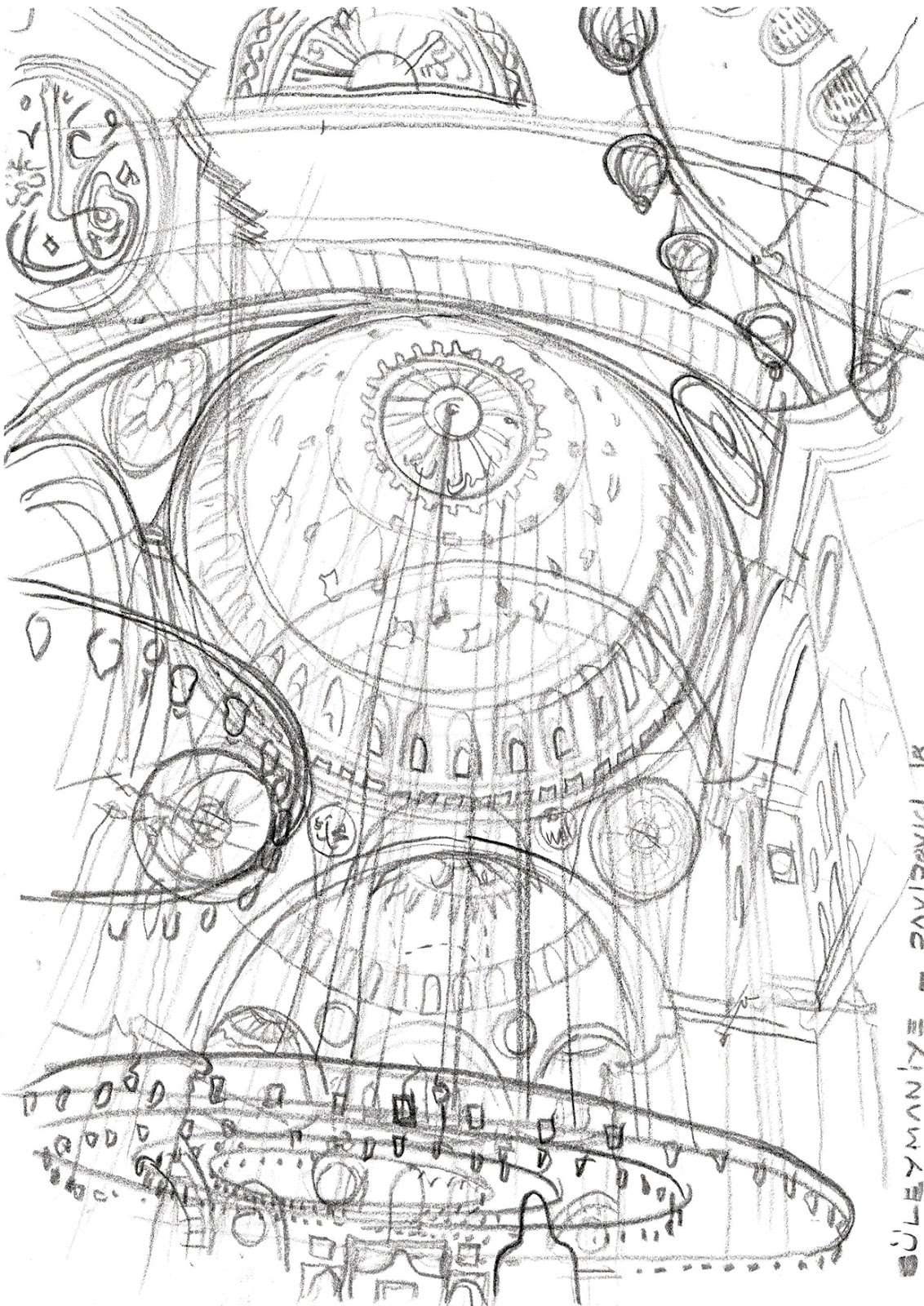
LANDED, 1-5
LANDED.
An intermediary step between Mars and the reality of the immediate 'here', this series of drawings is a quest on a series of questions:
Is fantastic architecture closer to reality when placed in town?
Does simple contextualisation bring drawings closer to becoming actual buildings?
Is the city of Milan (like many others, jealously guarded in its more or less ancient shape, with a downtown barely allowed to grow) rightly keeping its character, or just turning into an ossified postcard town?
One way or another, it's good to forget for a while about square meters, 60-degree angles, bureaucracy and functionality, to ride free above the roofs of the city.
END OF THE SPACE AGE, JULY 2011
LOOKING FOR A MEANING IN ARCHITECTURE
Architecture used to be invested with particular significances that in our turbulent, agitated age have been lost.
Any building – though particularly houses and temples - used to be considered a small model of the World, as it was seen as symbolically unifying in a whole the three levels of life. The foundations stuck deep in the dark, material Earth, the roof, immersed in the full light of the spiritual sky and the walls, doors and windows on the horizon of the human life.
Building was therefore not considered a mundane activity but a deeply spiritualized one, a direct continuation of the Creation itself. Across all cultures, houses or temples – and by extension settlements themselves - were ‘working’ within the local culture and religion to help people understand their own place on Earth (see drawing). The symbolic power of the message they used to convey was universal and we still feel it today.
Nowadays the situation is radically different. Most of us don’t seem to have anymore a clear idea of what we are doing on this planet. The amazing development of science in the last few centuries have made us the depositaries of unprecedented levels of knowledge. We can literally peer further in space and time than ever before. The question ‘how’ – how the Universe works - is been answered with more and more clarity. But the question ‘why’, why we are here and what is the purpose of our existence on Earth, is not. The centuries-old preoccupation of religions and philosophy has little relevance for the everyday life of well-fed people, it seems. And as always Architecture faithfully follows our mindset. Buildings are not anymore a symbol of the World – they have become the World itself. It is hard to discern in the contemporary agglomerations the sense of clarity obvious in any Medieval town.
But wait a minute. The mad urban universe we are creating to ourselves is a hugely complex entity that could be seen as talking, in millions of tones and colors, about the huge complexity of life and Universe itself! The contemporary agglomerations may therefore be seen as better - if definitely less clear - symbols of a complex Universe than the primitive – if charming – earlier ones.
The amassed architectures of ever-growing megalopolis do tend to be schizophrenic and self-referential. They do disorient and hardly seem to reflect any preoccupation beyond the most material ones. But buildings still have their foundations stuck deep in the dark, material Earth, the roof, immersed in the full light of the spiritual sky and the walls, doors and windows on the horizon of the human life.
Maybe all what is needed in order to restore to Architecture – and to the world it creates – its original sense of meaning is some simple, light intervention focused more on revealing to us what is already there than on creating something new?
IMAGINARY JERUSALEM, 6

IMAGINARY
Like a supersonic aircraft leaving behind its own sound, the mental representation of a city can be so powerful that the actual city – though strengthen by its own reflection – is simply left behind.
So much
Real Jerusalem is still there, I know it well, I used to live there, yes it is the same city sung and missed for millennia, fought for and claimed by Jews and Christians and Muslims alike, but it lives its actual life with its normal rhythms, with its buses and markets and living rooms and streets and trees. Interrupted sometimes by breathtaking views or by glimpses of ages-old history. Living its normal life, though under the shadow of a conflict so deep, so old, so multifaceted that it looks as natural as the strong light bouncing on the stone of the city.
MARS ARCHITECTURES, 7

WHY MARS ARCHITECTURES
- the dictatorship of function in architecture. The power of architectural space. drawing as a way to escape the dictatorship of function.
Function has been driving architecture since people started to build at the dawn of history.
We are so used to build with a purpose that we don’t even ask ourselves why we do it. Even purposeless buildings (or parts of them) have a purpose, be that only to provide a proof of personal standing.
Architectural space is one of the most powerful expressions of art.
Because no other art form (maybe except music) physically contains you.
Because looking for a meaning and a way in a space is a built-in instinct of a wandering species. Therefore when in contact with a coherent space we immediately start to look for meanings and ways and we find great fulfillment in doing it.
Because architectural space quiet naturally offers clues about the nature of the Universe itself - even the most stupid building is still both a model of the Universe and an evident actual continuation of the Genesis/ Big Bang.
Architectural space could reach new heights as an art form if explored in full autonomy of any functional purpose?
To actually build a space whose purpose is to prove the artistic worthiness of a functionless space is contradictory, not to mention expensive.
Drawing, though evidently limited to flat 2Ds, can:
Walk you through spaces without actual need to build them;
Fruitfully excite your imagination. Precisely in the way a book excites you more than a movie – because it forces your mind to create itself a complete 3D model of a particular space out of the partial image the eyes meet. Therefore no two persons will ever see the same drawing in the same way. The viewer is an integral part of the drawing.
- Mars, the perfect place.
Because Mars is wonderful. It is empty, clean, free, windy, mysterious, red. Earth is that little dot on the sky.
It is so far as to make us almost sure we will never touch it. And it is so close, as we perceive it with its boulders and dust and sand and pale sky though the eyes of the Mars rovers, as to allow us to recognize it. To understand it as a place where, yes, we can be.
Because the functions of any Mars settlement, be it made by near-future humans or by far-future post-humans or by the famous little green local cousins of humans are so, so, so completely obscure to us – answering to an unknown society in an unknown environment - as to become totally, completely, absolutely irrelevant. Therefore we can read the architectural space of such a place as pure art.
Because a special relationship can be created with the powerful landscape, in a way we can’t do anymore but in rare isolated projects far from our schizophrenic urban conglomerates.
- The freedom to explore Mars is the freedom to explore your own inner world.
Because both are unknown, endless, full of surprises, immensely far and very close.